Real websites, built from your real brand
Every site here is multi-page, hand-built, and made from the actual business: its services, its reviews, its history. Not a template with a logo dropped in. And when a trade needs more than a website, we build the platform too.
We build it first. You pay only if it is better.
Most of the risk in hiring anybody is paying before you know what you are getting. So we take that part out.
Your replacement site gets built, with your real content in it, before you have paid anything or signed anything. Then you look at it.
This is not a trial, a teaser, or a watermarked preview. It is the real site, finished, on a real domain, with your services and your reviews in it. Start with a free teardown if you want something smaller first.
Sites we have built
Nine complete, working multi-page sites across roofing, custom homes, HVAC and plumbing, veterinary care, auto repair, and editorial. Open any of them on your phone right now. None is a mockup, a template, or a concept.
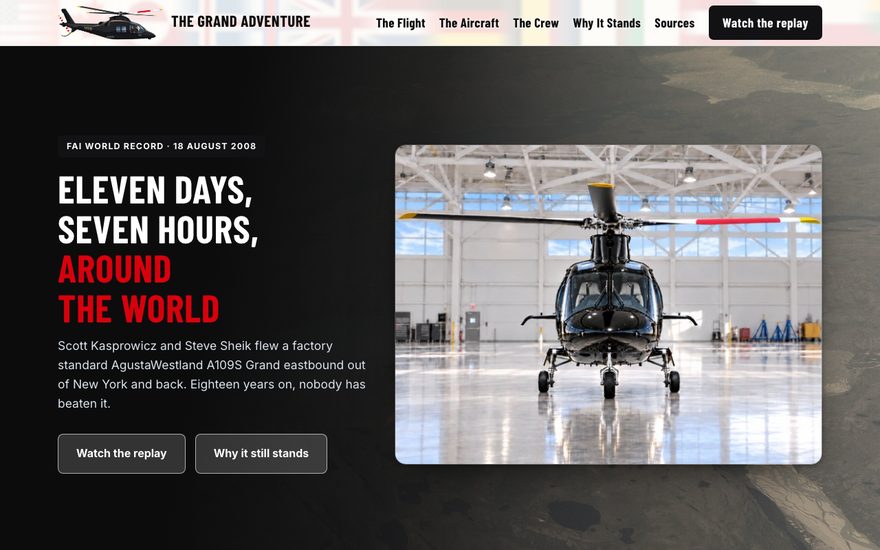
The Grand Adventure
The 2008 FAI round-the-world helicopter record, documented properly. Six pages, a cited sources section, and the full 11-day route replayed on real terrain in the browser.
grandadventure08.com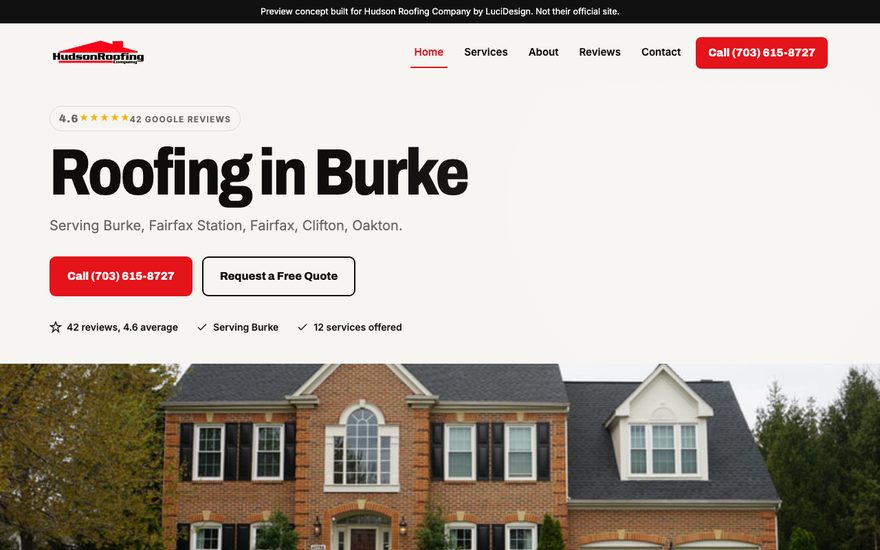
Hudson Roofing Company
Five pages built around a 4.6 rating and the towns they actually serve, with a quote request that does not make you phone anybody.
hudsonroofing.luciapps.com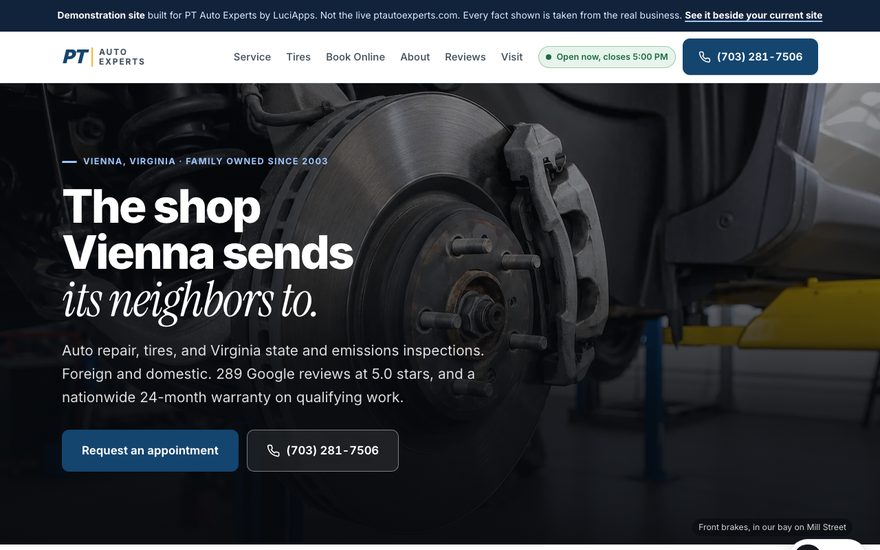
PT Auto Experts
Vienna, VA. Full-service repair, tires, and state inspections, with online booking and a side-by-side against the site they have now.
ptauto.luciapps.com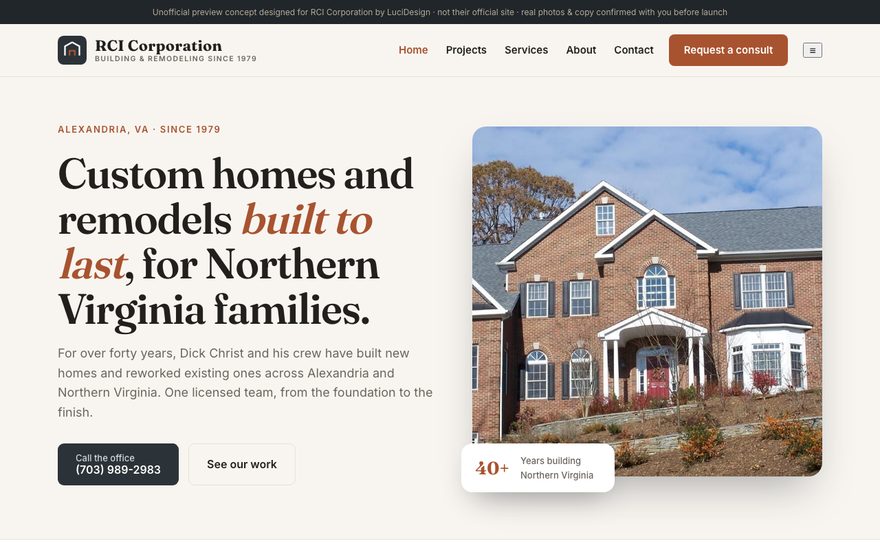
RCI Corporation
Forty years of custom homes and whole-home remodels in Northern Virginia, finally presented like the work deserves.
rci.luciapps.com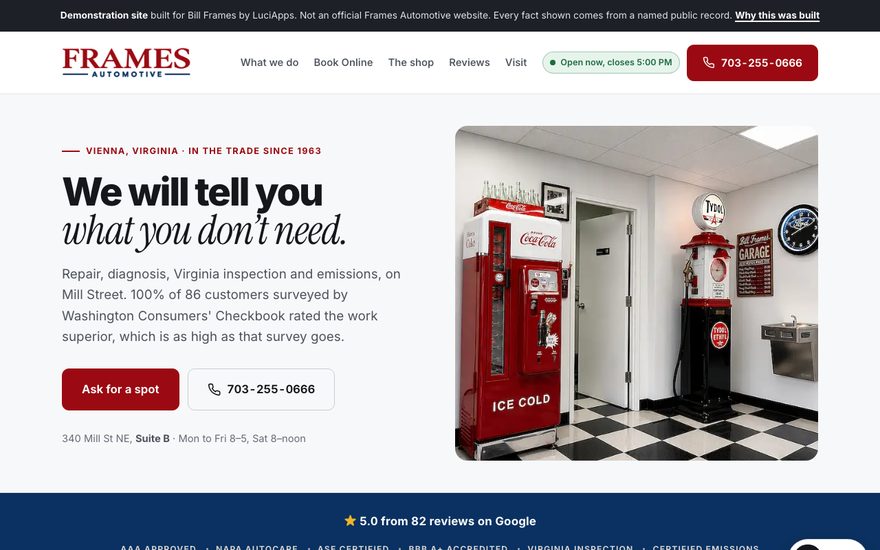
Frames Automotive
A shop already booked two months out. Built to cut wasted phone calls and put a 5.0 review record somewhere the shop actually owns.
frames.luciapps.com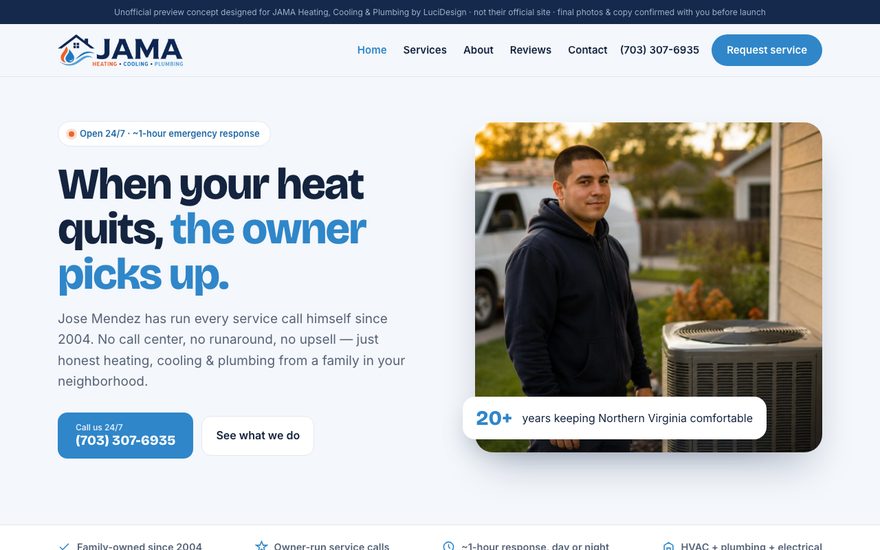
JAMA Heating, Cooling & Plumbing
An owner-run shop in Annandale whose whole pitch is that the owner picks up. The site says that before it says anything else.
jama.luciapps.com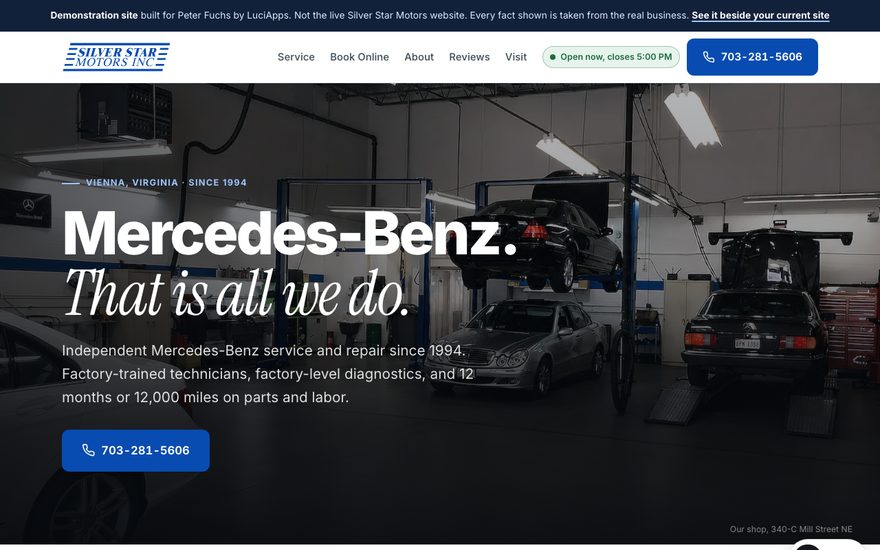
Silver Star Motors
Thirty-two years of Mercedes-Benz specialist work, finally on a site that loads, with the owner’s name and reputation at the center of it.
silverstar.luciapps.com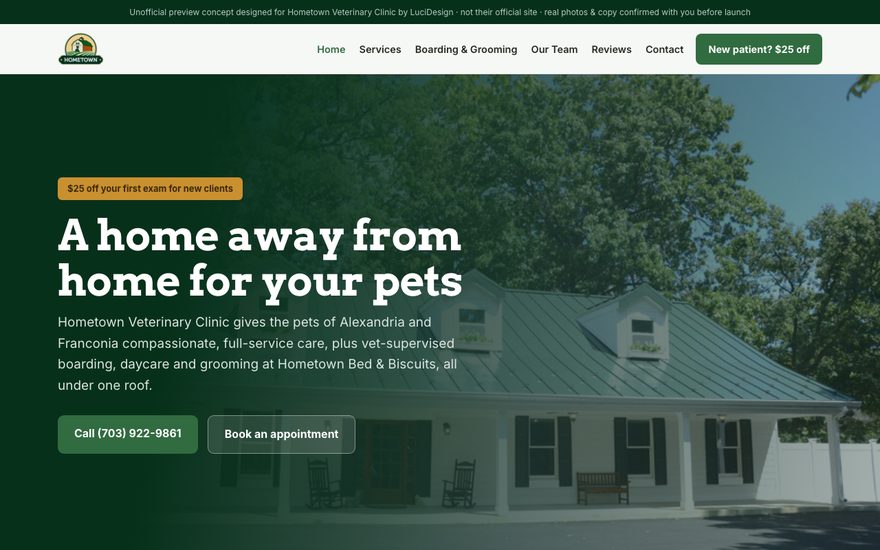
Hometown Veterinary Clinic
Full-service care, boarding, and grooming under one roof in Alexandria, with booking and a first-exam offer up front.
hometownvet.luciapps.com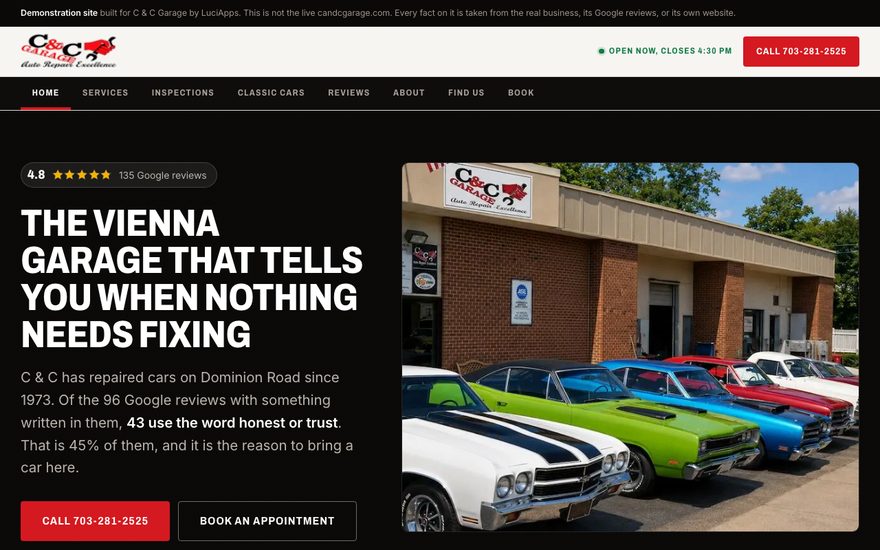
C & C Garage
A Vienna institution whose site still ran on a 2007 newspaper clipping. Rebuilt around the two owners and the people customers actually name in reviews.
candcgarage.luciapps.comSites built for a business ahead of a decision are published unindexed and labeled as demonstrations on every page, so nobody mistakes one for that company’s official site. That is the method: the business sees the finished replacement before anyone talks about money.

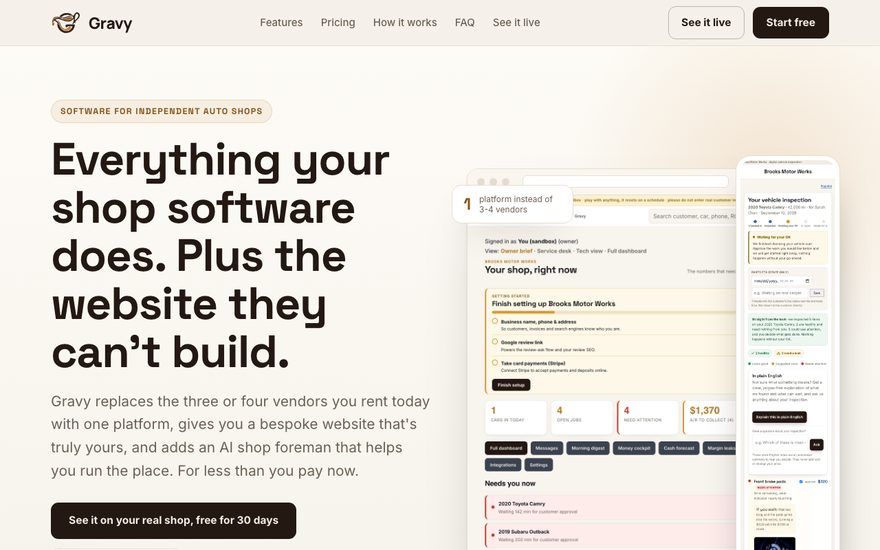
Independent auto shops rent three or four different vendors and still do not get a website worth having. Gravy is one platform that replaces the stack and includes the site.
Everything your shop software does. Plus the website they can’t build.
Digital inspections with photos, online booking that knows your real capacity, an AI shop foreman that answers from the shop’s own records, reviews, follow-ups, memberships, payments, and a bespoke multi-page site built from the shop’s own brand.
Digital inspections
Color-coded, a photo per line, price-locked, with a plain-language explanation of what happens if you wait.
One dashboard
Jobs, approvals, money owed, and what needs attention right now, in one place instead of four tabs.
Reviews and follow-ups
Real Google reviews on the site, and follow-up that goes out without anybody remembering to send it.
The website
A bespoke multi-page site built from the shop’s real services, not a template. Part of the platform, not an add-on.
Gravy, the product
What it replaces, what it costs, and how a shop gets moved over.
gravyauto.luciapps.com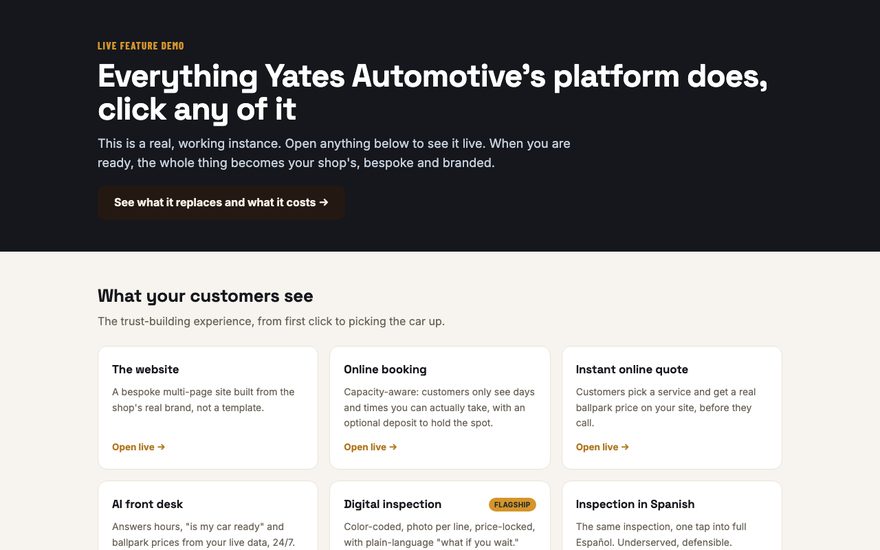
See it running
Gravy’s own site carries working demos throughout: the inspection, the booking flow, the foreman, the dashboard.
gravyauto.luciapps.com/live
The site a shop gets
Silver Star Motors, built from the shop’s own brand, services, and reviews. This is the part the other shop-software vendors do not do.
silverstar.luciapps.com
A free app on the surface. Underneath it is a measurement network: years of wait-time history across the North American regional park industry, a forecasting engine tuned park by park, a published error record, and a simulation twin used to answer questions a park cannot test on a live Saturday.
The app is how the data gets collected and how guests get paid back for it. The platform, the benchmark, and the consulting work built on top are the product.
A day that runs itself
Wait times are the easy part and everybody has them. The work is in what you do with them once a family of five is standing in a plaza at 11am with one tired child and a dinner reservation.
Planning the day
- Live waits across every ride in the park
- Smart Route, an ordering of the day built to cut time in line
- Crowd forecasts before you commit to a date
- Per-ride predictions, not just a park-level number
- Re-planning when the park stops behaving
Keeping the group together
- Close-friends location sharing inside the park
- A wristband track for children without phones
- KeepSafe for phones and belongings
- Group coordination that survives a split-up
- Reunion flows for when somebody wanders
The rest of it
- Automatic ride detection and a credit history
- Badges, streaks, and a coin economy
- Park and coaster history for hundreds of rides
- A watch companion for glanceable waits
- Free, permanently, with no ads
The half of the audience pricing cannot reach
Season passholders are a majority of regional park attendance, and their marginal ticket price is zero. Twenty-five years of yield management cannot move them, because the money was paid months ago.
The only instrument that moves a passholder is information about which day to come. And a park cannot supply that credibly, because everyone knows it has a reason to call every Tuesday quiet.
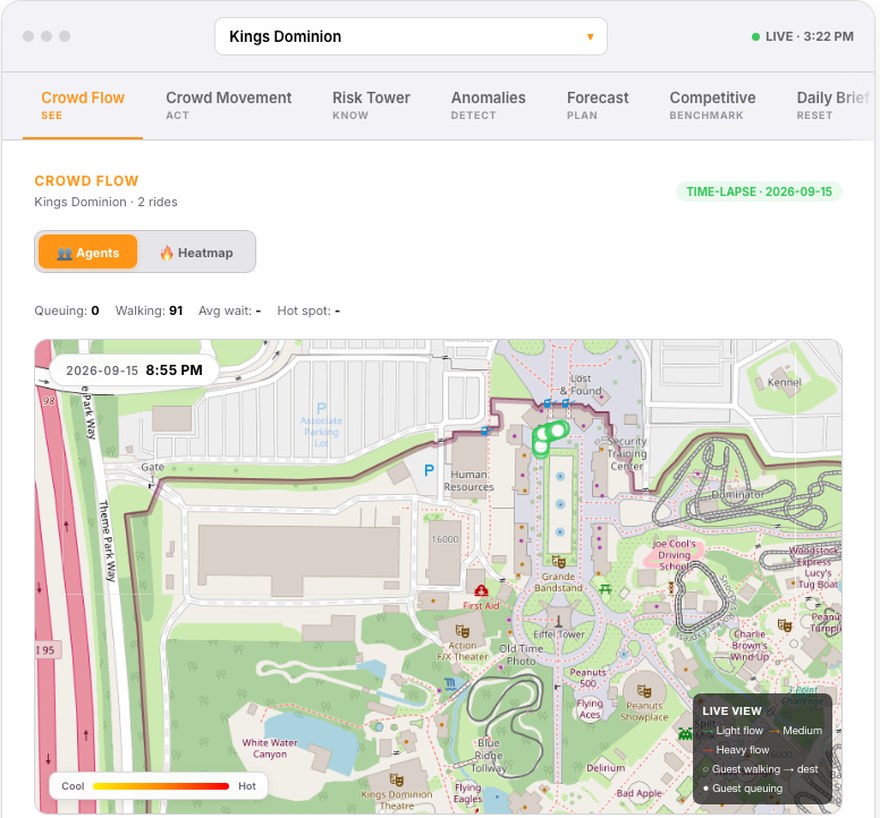
Crowd Flow, running against a real park. Agents move on the park’s own map, with a heat-map view over the same data. This is the operator product, live at parks.thoosie.app.
Seven views, one park
Everything an operator gets is built from feeds parks already publish. We own no hardware, install none, and no guest needs the app for any of it to work.
See and act
- Crowd Flow, where guests are right now
- Crowd Movement, where to push them next
- Agents and heat map over the same park
Know and detect
- Risk Tower, what is about to go wrong
- Anomalies, what already has
- Flagged against the park’s own normal
Plan and benchmark
- Forecast, what tomorrow looks like
- Competitive, rank against a comp set
- Daily Brief, the morning reset
What does a $30M coaster actually do to your park?
Operators mention capital projects and new rides in their annual filings more than any other theme, and ride availability least of all. The industry’s biggest budget line is also its least modeled decision.
A major group spent close to half a billion dollars on capital in a single year. The question of what any one of those rides does to park-wide flow, queue distribution, and spend per guest is usually answered by judgment and a spreadsheet.
Measuring what a ride did
When a new ride opens somewhere, the surrounding park changes in ways that show up in the wait data immediately: where queues form, which attractions lose traffic, how the shape of the day shifts. We have been recording that across the industry for years.
- Before-and-after measurement against the park’s own history
- Comparison against parks that did not open anything that season
- Effects on neighboring attractions, not just the new one
- How long the opening bump actually lasted
The park twin
A simulation of a specific park, built from its real layout, its real walking paths, and its own measured behavior, so a ride that does not exist yet can be placed in it and the day re-run.
- Put a proposed ride at a proposed location and watch the flow change
- Test capacity and placement before either is committed
- See which existing attractions absorb or lose the traffic
- Compare two candidate projects against the same park day
Why it can be calibrated at all
Digital twin projects usually die on calibration, because the customer has no ground truth to check the model against and everyone ends up arguing about assumptions.
This one has an unusual advantage: years of measured wait behavior across the industry, and every new ride opening at every other park as a natural experiment to test a counterfactual against. The model can be made to reproduce openings that already happened before anyone is asked to trust it on one that has not.
Stated plainly, because it matters for scoping: the full walking-path network behind the twin is built for one park today and extends park by park. The measurement work behind it spans the industry. An engagement starts with the park you actually care about.
We can test an intervention before a park tries it
Forecasting tells a park what is about to happen. The harder question is what to do about it, and no operator can experiment on a Saturday to find out.
So we built the place to experiment instead: a simulation of a full park day with eight thousand independent guests, each with their own tolerance for queues, walking distance, hunger, and heat.
What it models
- Eight thousand guests, each deciding independently
- A full operating day in five-minute steps
- Real ride capacities, durations, and park geography
- Queues, walking, eating, breakdowns, and giving up
- Dozens of hidden behavioral traits per guest
What we do with it
- Try a nudge and watch where the crowd goes
- Compare interventions against each other, not against a guess
- Find the ones that backfire before anybody ships them
- Search the space automatically rather than by hand
- Rank features by what they would actually move
What it has already killed
- Features that looked obviously good and tested negative
- Steering that was too blunt and disrupted ride flow
- Approaches that helped one area by wrecking another
- Our own assumptions about which signals matter
- Ideas we would otherwise have built first
This is a decision tool, not an oracle. Its own validation run reports where it does not match reality, including queue shares that run higher than real parks and absolute wait minutes that are not calibrated against observed data. It earns its keep by ranking interventions against each other, which is a much weaker claim than predicting a Saturday, and the only one the model supports.
The number that counts is the forward one
Any forecaster can score well against data it was trained on. The only figure worth publishing is how it does on days it has not seen, which is a materially harder and less flattering test.
This is the same evaluation discipline described on the AI and agents page, applied to our own product rather than a client’s. Publishing the weaker, honest number is the entire point: a forecast nobody can audit is worth nothing to a park deciding where to move a crowd.
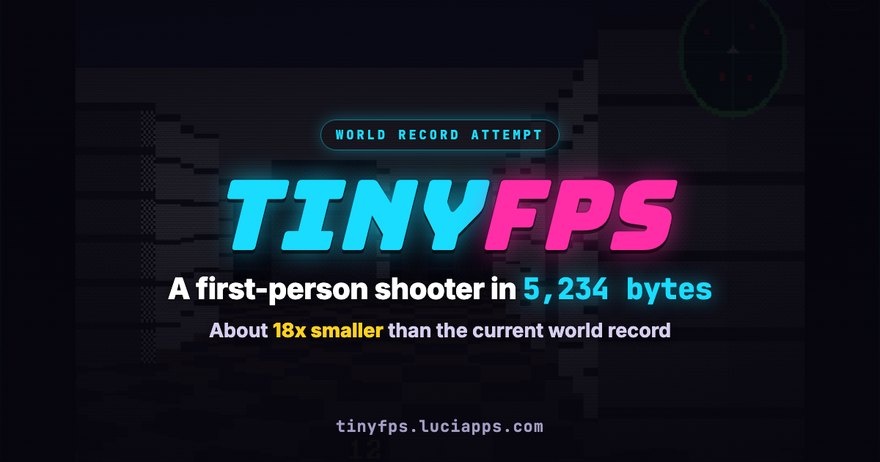
The standing world record for the smallest FPS has held since 2004 at 97,280 bytes. tinyFPS is a complete, playable shooter about eighteen times smaller, written from scratch in x86 assembly, and the application to break that record is in with Guinness.
How a website gets built here
Audit first
We read your current site, your reviews, and your competitors, and write down what is actually broken.
Build the real thing
You see a complete, working multi-page site with your content in it. Not a mockup, not a theme.
You decide
Open it on your phone, show it to your people. If it is not better than what you have, we part friends.
Live and maintained
We launch it on your domain and keep it current. No lock-in, and your content leaves with you.
What a website build includes
Every build starts from the same base. What changes is how much of it a given business actually needs.
What owners ask first
The Studio page covers how the studio runs. These are the questions specific to a website or platform build.
Why did you build my site before asking me?
Because a finished site is a better argument than a pitch, and it respects your time more than a meeting about a meeting. You look at the real thing and decide. If it is not better than what you have, nothing is owed.
I already rank fine on Google. Why bother?
Often you should not, and we will say so. When it is worth it, it is usually not about more customers at all. It is about fewer wasted calls, control of your own name, and stopping the monthly fee you pay for something nobody has opened in years.
What happens to my current site?
It stays up until you say otherwise. The switch is a DNS change, done at a time you pick, and reversible the same day.
Is Gravy just a website?
No. The website is the part other shop-software vendors cannot do. Gravy also carries digital inspections, booking, payments, reviews, follow-ups, memberships, and an AI foreman that answers from your own shop records.
Want to see yours built?
Tell us the business. We will build the site first and show it to you before we talk about money.
Get a free teardown